
Mural Art: Joel Arroyo
Storytelling: Oana Maroti
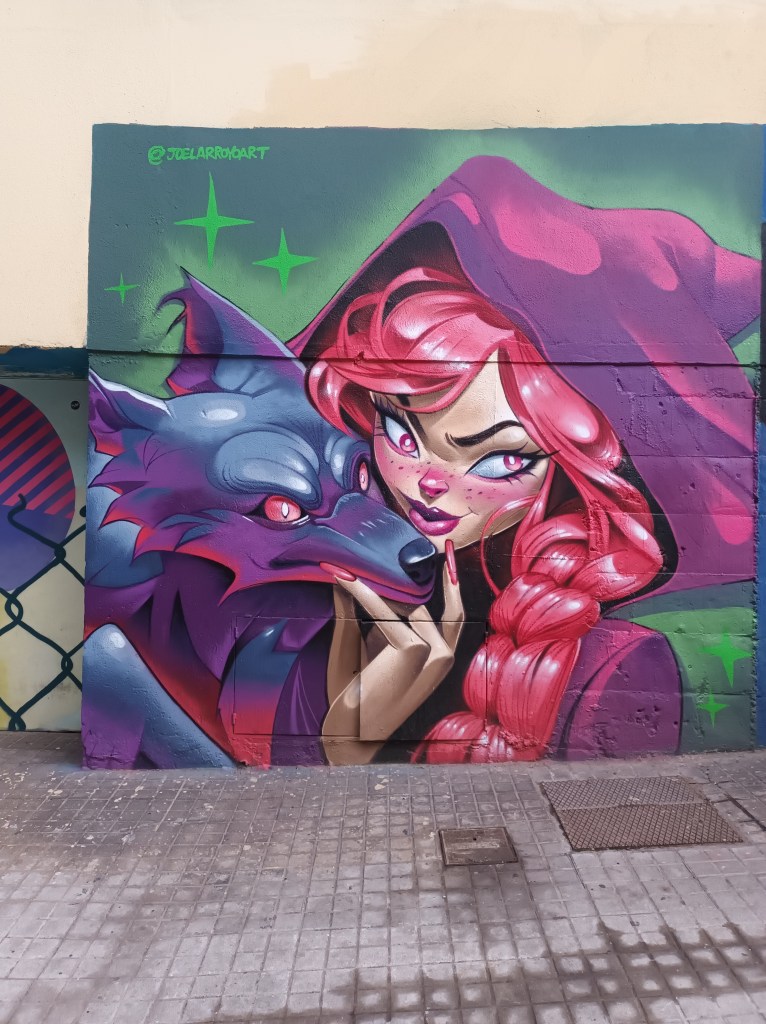
Such a refreshing image of a bold Little Red Riding Hood taming the wolf.
Street art has this wonderful way of reinterpreting the victim as the villain and this wall is almost saying: Hey you, Wolfie, be careful with that Little Red Riding Hood, she might tame you, make you her dog!
For women, these messages are comforting, and underground art is doing a great job of showing the strong feminine part. There are more probabilities to find women characters that stand up from the painting pointing their gaze at you by walking the streets and interacting with the underground culture than in a big museum where ladies are pictured mostly as wives or working hard slaves and the most daring paintings made were of courtesans or prostitutes, many of them much too young and wearing alienation and unhappiness in their eyes.
This graffiti mural was made by Joel Arroyo at Boca Nord and it´s a women´s rights graffiti, but also an ecologic mural. It´s about a strong connection with the nature that people in Horta have and about strong ladies who do not fear dangers, but confront them and change things.
The tale of Little Red Riding Hood is a universal, ancient story of a little girl followed by a bad wolf in the woods. The story can be found in all parts of the world, mutated into other stories, and has links with other later myths and fairy tales, therefore an oral transmission. This character might be the skeleton of the biggest super-heroes that ever existed.
It is considered a European fairy tale and in its written version that we know from Perrault, it is a horror story in which the grandmother and Little Red Riding Hood are both devoured by a wolf that does not act like a wolf, but rather turns to drama and manipulative dialogue. In his version of the story, Perrault makes an allegory of child abuse and a clear introduction to the psychology of the young woman who is not able to identify the disguised danger and therefore cannot protect herself, and the same goes for the third age.
In Perrault's version, women are staged as in Lolita´s story, as the manipulative wolf is described more as an evil adult than a creature of the woods, pointing out the mental disequilibrium of a human predator who attempts to seduce a child.
Perrault's version is a bit grotesque, but closer to reality. It is a custom that girls use to take care of others, even little girls. Eastern European mythology is full of examples of this kind, and yes, there are dangers. As in real life, the woods are not as problematic as the predators that can follow small children into them. The wolf might change clothes or characters, but its intentions remain the same.
If you are ever curious about these kinds of horror predator stories, just talk to the elderly in the occupied territories, where there are plenty of examples of courageous little girl travelers and even way too early mothers who had to run away and survive in the mountains. Sometimes the reality was so terrifying that society had to push an imaginary monster to cover it.
In the Brothers Grimm version, the ending is made up and Little Red Riding Hood escapes with the help of a friend. There are many interpretations of the Brothers Grimm version that offer a happy ending to the story and insist on transforming the victim into a survivor character, a victor in the face of life's great dangers.
Joel Arroyo's version is a derivation of the Brothers Grimm, or in contemporary terms the transformation into a superhero. The whole mural has a delicious lilac vibe, purple tones that open to magenta and even the black wolf has an indigo glow.
I took this photo on a cloudy morning, which is usually a problem with graffiti art and my phone not being very capable, but it was not the case, considering the palette of this painting.
I recently took this photo while visiting a miniature but impressive bakery across the street from where the painting was. From admiring the bread and pastries I pass on the street to admiring a redheaded woman with a wheat ponytail hairstyle under a magenta cape coat that is specific in cold areas. Her gaze is mean, like the gaze of a villain and the wolf is docile in her arms and more like a domestic dog.
It's autumn and as I was walking around a certain graffiti caught my eye with its visual familiarity of the magenta palette that I associate with the types of prunus and the changing color of the fruit as it ripens and turns darker.
In Joel's art, Little Red Riding Hood is a young woman, she is no longer a child, she is strong and wise, able to communicate with nature, to connect with animals, so instead of having an enemy on her back, she is now painted with her indigo wolf friend. She is no longer a victim, on the contrary, we see a powerful Little Red Riding Hood, and we could just as easily assume that the domestic wolf is cute, but that it could bite or even worse if a predator attacks the girl.
Self-protection techniques have been told since forever and each story derived from a myth has its own local variations of educational storytelling.
The tale of Little Red Riding Hood is used as an educational story aimed at protecting children, a topic that has preoccupied many writers and artists throughout human history, who have formed a universal network of child abuse prevention. We can look at the arts concerned with this delicate social subject and exhibit the grotesquerie of inequality and male domination, which when imposed on children is ultimately perceived as intrusive and unacceptable.
In addition to the mystery of: What is she carrying in the basket? And what kind of red and what fabric was her coat? What I find particularly interesting is that this story is known in other parts of the globe as having a tiger or other large representative animal as a negative character.
The world abounds in horror crimes and traveler stories. We have been told that girls and women alone are sure victims, but this is not the story I know at least from the local narratives I have been told, where women and children are always accompanied by their trusted dog when they travel even from one hill to another, nor from the first detective novels I heard that featured women with their trusted animal (not always a dog, usually a bird) to decode the mystery of the murder.
Underground art reminds us that in all cultures there are women fighters who have overcome incredible trials and survived by coming into contact with the wild nature.
The feminine presence in botanical knowledge or animal domestication is undeniable, and what appears as an inferior physical force can reach through knowledge a mental super-force and defeat any possible predator, human or animal, whatever its dimension.
🎧:
 Underground Art & Literature - open access to culture