
Bilingual Social Essay fragment by Oana Maroti
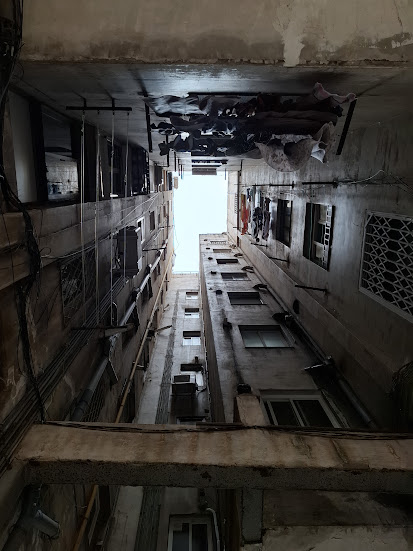
Las ciudades se forman por barrios, que en su momento fueron colonias de personas que se unieron a la ciudad. La literatura universal explica cómo se formaron y cómo generaciones enteras de personas trabajaron para hacer posible la arquitectura; posteriormente, todos los servicios se incorporaron a la ciudad via los trabajadores, es decir, debido a personas que llegaban de otros lugares.
En español, barrio es una derivación de barri, que literalmente significa acumulación de personas de fuera. En árabe también significa gente salvaje.
Por lo tanto, una barrio seria una aglomeración de diversos orígenes, culturas, actividades, creencias, hábitos, cohabitando.
Tuvimos estas aglomeraciones de diversidad en las zonas ocupadas y, posteriormente, esta cohabitación masiva se concretó en las grandes ciudades. Se construyeron bloques de edificios y surgieron nuevos barrios porque la vivienda para los trabajadores siempre fue un problema, debido a la desigualdad de trabajar sin remuneración o a tener ingresos incompatibles con el pago del alquiler y la cobertura de las necesidades básicas con los ingresos mensuales. Grandes grupos de personas tuvieron que adaptarse, forzosamente, a las condiciones impuestas.
En la zona del Carmel, por ejemplo, en Barcelona, donde se encuentran los búnkeres, aún se puede observar el collage de azulejos y partes de lo que fueron casas de la gente, con materiales que podían conseguir, mezclando así los estilos. El Carmel sigue siendo un barrio con poca visibilidad, incluso después de tanto tiempo.
Otro barrio donde nacieron o crecieron celebridades españolas estaba junto a la playa barcelonesa, donde había un barrio de chabolas lleno de familias inmigrantes que finalmente fueron simplemente expulsadas, continuando un problema antiguo que persiste hasta hoy en dia.
Esta práctica de expulsar a personas que vivieron toda su vida en zonas vulnerables, en lugar de resolver el problema y ayudar literalmente a la comunidad, crea muchos problemas: traumas generacionales, estancamiento del desarrollo, falta de cobertura de las necesidades básicas y, por consiguiente, criminalidad.
He visto y vivido en lugares como Cartier y Barrio, algunos maravillosos, que incluyen y aceptan a las personas de dentro, lo que da una sensación de comodidad y protección dentro de la comunidad, donde los malos protegen a ancianos, mujeres o niños. Pero también he vivido en mundos paralelos, en barrios y vecindarios donde las personas se protegen a sí mismas y al espacio común que no quieren compartir, alejando la novedad y excluyendo del grupo, utilizando estrategias desagradables. Es un comportamiento cerrado. Tal mentalidad de rechazar en lugar de incluir se observa en todas las metrópolis, y es responsable de la existencia precaria en las zonas limítrofes.
Como señalan muchos libros, canciones y películas, donde no hay visibilidad y la aporofobia reina, se crea un entorno abusivo, y un entorno abusivo tiene una dinámica devastadora. Los motivos son diferentes, pero en esencia se reducen a creencias insostenibles y al colonialismo. Por lo demás, cada libro importante enseña explícitamente y paso a paso que el éxito social reside en aceptarse mutuamente.
Los barrios o vecindarios que no tienen acceso a servicios necesitan tener acceso a ellos y ofrecer una vida mejor. Sin duda, estas personas sostienen la economía. El problema es que son utilizadas sin remuneración, dejádas en una situación de vulnerabilidad y, por lo tanto, sacrificadas.
La burocracia puede ser tan absurda que las personas viven sin derechos mínimos, trabajan durante décadas y pagan alquileres exorbitantes en comparación con sus ingresos, lo que les deja con un futuro impreciso y un desarrollo estancado.
Aunque las condiciones no sean las mejores, en estos entornos surgen personalidades fuertes y modelos a seguir; personas que no solo superaron la falta de posibilidades, sino que fueron y son brillantes y únicas, y dedicaron su trabajo a la comunidad. Y donde hay buenos ejemplos a seguir y paz, el apoyo mutuo tiene una gran influencia y el desarrollo es posible.
En los barrios, hay personas que comparten poco espacio; algunas aún pueden contar cómo superaron el hambre en momentos difíciles y conflictivos apoyándose en la cooperación social. Como estudiante formal, compartir poco espacio con otros estudiantes era la peor condición de vida: un gueto universitario, de 5 a 7 personas en una misma habitación, poniendo cada uno algo para hacer una sopa al final de semana y no pasar hambre durante exámenes. Así es como las futuras generaciones tuvieron la oportunidad de prepararse... Ahora creo que sobrevivir durante universidad es aún más selectivo, ya que la vivienda se ha convertido en un problema cada vez mayor en los últimos años.
Se excluye a tipologías específicas de personas, y todos aquellos a quienes se les niega el acceso forman un grupo consistente a nivel mundial. Es importante abordar el tema de la vivienda desde la perspectiva de los derechos humanos, para que las leyes puedan abordar la inclusión y hacer su trabajo, ya que esto es lo que necesita una sociedad desarrollada.
<-><-> EN:
Neighborhood
Cities are formed from neighborhoods, once colonies of people who joined the city. Universal literature explains how towns were formed and how entire generations of people worked to make architecture possible; later, all services were incorporated into the city via workers, that is, through people arriving from other places, in other words, cities are up grace to immigrants.
In Spanish, barrio is a derivation of barrí, which literally means "accumulation of people from outside." In Arabic, it also means "wild people".
Therefore, an agglomeration of diverse origins, cultures, activities, beliefs, and habits, cohabiting. We had these agglomerations of diversity in the occupied areas, and later, this massive cohabitation took shape in large cities. Blocks of flats were built, and new neighborhoods emerged because housing for workers was always a problem, due to the inequality of working without pay or having incomes incompatible with paying rent and covering basic needs with monthly income. Large groups of people were forced to adapt to the imposed conditions.
In the Carmel area, for example, in Barcelona, where the bunkers are located, you can still see the collage of tiles and parts of what used to be people's homes, made with materials they could obtain, thus mixing styles. Carmel remains a neighborhood with little visibility, even after all this time.
Another neighborhood where Spanish celebrities were born or raised was next to the Barcelona beach, where there was a shantytown full of immigrant families who were ultimately simply evicted.
This practice of evicting people who had lived their entire lives in vulnerable areas, instead of literally solving the problem and helping the community, creates many problems: generational trauma, stagnation of development, lack of coverage of basic needs, and consequently, crime.
I've seen and lived in places like Cartier and Barrio, some wonderful, ones that include and accept people from within, giving a sense of comfort and protection within the community, where even the bad guys protect the elderly, women, or children. But I've also lived in parallel worlds, in barrios and neighborhoods where people defend themselves and the common space they don't want to share, shunning novelty, practicing exclusion, and using unpleasant strategies. It's closed group behavior in a large group setting. The mentality of rejecting rather than including appears in every metropolis and is forming marginalized zones.
As many books, songs, and movies point out, where there is no visibility and aporophobia reigns, an abusive environment is created, and an abusive environment has devastating dynamics. The reasons are different, but they essentially boil down to unsustainable beliefs and colonialism. Otherwise, every important book explicitly and step-by-step teaches that social success lies in accepting one another. Neighborhoods lacking access to basic services need access to them and from there they can have a better life.
These people undoubtedly sustain the economy. The problem is that they are used without compensation, left in a vulnerable situation, and therefore sacrificed. Bureaucracy can be so absurd that people live without basic rights, work for decades, and pay exorbitant rents compared to their income, leaving them with an unclear future and stagnant development.
Although social conditions may not be the best, strong personalities and role models emerge in these environments; people who not only overcame the lack of opportunities, but were and are brilliant and unique, and dedicated their work to the community. And where there are good role models and peace, mutual support has a great influence, and development is possible.
In the neighborhoods, some people share little space; some can still tell how they overcame hunger in difficult and conflictive times by relying on social cooperation. As a formal student, sharing a small space with other students was the worst living condition: a university ghetto, with 5 to 7 people in a single room. This is how future generations have the opportunity to prepare for the future. Now, I believe this is even more selective, as housing has become an increasing issue in recent years.
Specific groups of people are excluded, and all those whose access is denied form a consistent group, globally. It is important to approach the issue of housing from a human rights perspective so that laws can be quickly adapted and address inclusion, as this is what we need to function.
 Underground Art & Literature - open access to culture