Stencil Art: Guate Mao
Storytelling: Oana Maroti
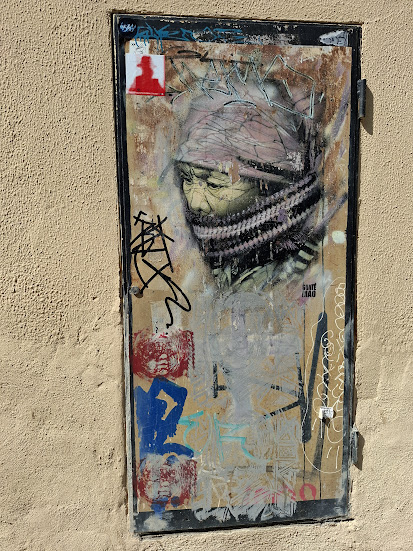
Mientras paseaba con mi patinete por las calles de Barcelona, en mis primeros años en España, podía observar cuánto talento e interculturalidad hay con solo mirar las esquinas, los muros, los espacios grises que permanecían allí, feos, incompletos, y de repente a alguien se le ocurre algo único y crea algo completamente nuevo, estético, a veces lírico, como en este caso.
I´m still trying to process the whole corrupt social services story in Barcelona that is more than creepy, with unimaginable levels of abuse and I cannot not observe that real creepy issues that were covered for long time are revealed in the streets years before and also the streets tell more about such nasty things than news.
If the town has issues and the social department is not satisfactory, therefore corrupt and abusive, take a walk. The streets are full of evidence, sometimes painted, otherwise specifically written. Street art comes in many ways, and let´s accept it as a form of creation and fight against abuse. I´m explicitly asking that street art gets visibility and more walls. It´s a style; give it space.
While walking around with my foot bike on the streets of Barcelona, in my first years I could observe how much talent and interculturality there is just by looking at the corners, the walls, the grey spaces that remained there, ugly, unfulfilled and them somebody comes up with some color and graphic skills and makes a whole new thing, an esthetical one. Sometimes lyrical, as in this case.
Guate Mao´s works are small, painted on metal, and very visible to me, since the first walk, when I had no phone with a camera included, nor a camera. I have memories of this style of stencil, portraits beautifully made and incredibly chosen, that reflect a difficult existence, full of abusive events and poverty episodes, that immigrants encounter abroad.
The streets bear witness to all these difficulties. It is on the streets that we see evidence of the attacks and injustices committed in the neighborhoods. It is on the streets, inscribed on walls, cement, and metal, that we see the victims trying to communicate, desperate because justice is selective, or even completely absent. Life-and-death situations unfold on the streets. People suffer daily and cannot speak out.
Such an image like this portrait of an indigen woman made by Guate Mao speaks volumes just by looking at it. There´s resilience I see, and a sea of sorrow in each small detail of her facial expression.
Integrated in the urban landscape, inserted into the collective memory, still fighting for the habitat and a free life.
How is it possible that the underground culture makes more effort to solve injustice, and by this putting themselves in danger, than the departments responsible for supporting and protecting people? How is it possible that injustice appears on the streets, in our face, yet the media hardly speaks about it?
For the moment, those trying to speak out about crime and heavy stuff that nobody else speaks about are punished, even sent to jail for painting. That´s not what justice means. Send them to a place where painting is allowed, give them space, or hire them to paint jails, to transform walls, but don´t touch the messenger.
Underground art just communicates. Don´t close the communication and show that there´s nothing to hide, so we might solve the huge, chained corruption issues.
 Underground Art & Literature - open access to culture