She-Migrator series by Oana Maroti
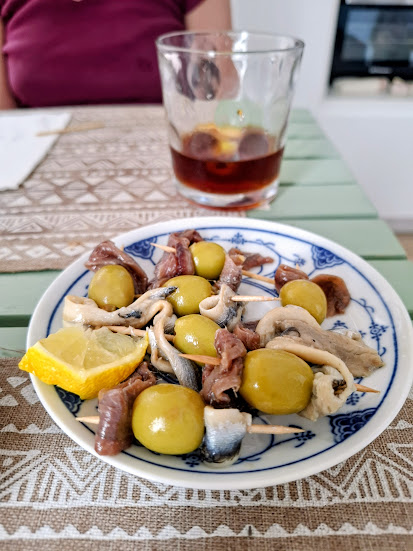
The ice is melting very quickly in the vermouth glasses.
After swimming, two migrant women start snacking and drinking vermouth. We are in Spain, in a village with access to the sea, the village of poets.
We have been meeting up to eat together or have a snack with vermouth for many years now. We were coworkers at an abusive company that placed us in a kind of constant instability, plus terrible bullying at work and situations of inequality, ableism, xenophobia, misogyny, and now ageism, which neither of us would have imagined would happen to us to such an extent that we instinctively isolate ourselves to avoid problems.
We have lost coworkers and friends, and even the places we used to call home over all these years, and the effort to integrate was enormous. Each of us is in a vulnerable situation, without a place of their own, facing constant labor exploitation, institutional indifference, and increasingly expensive housing.
The fluctuating situation becomes even more difficult when any cry for help is in vain. Institutions and bureaucracy jump from one official language to another, and the dynamic is the opposite of inclusion, even in medical centers. We have heard and unfortunately understood terrible, disgusting, and dehumanizing things, even when exercising basic rights, such as asking for guidance to an institution or using medical services.
We speak Spanish, although we could speak English, as we are usually required at work. However, for both of us, Hispanic culture is important. Being born in different countries, we have been interested in Hispanic culture and society before arriving, and each presence is more connected to cultural than economic premises. Even so, the chances of integrating into Catalan society are minimal to nonexistent. For formal issues, the interactions in Castellano, the official Spanish at the country level, can be negative, even when you want to borrow a book from the library, an incredibly pitiful situation I had already encountered once in Corsica. Interfering with the reader is of maximum bad taste, as literature has fought hard to open access.
We have some pintxos prepared on the table, which we'll nibble on and make more. They're delicious and perfect for aperitifs. They're delicious and perfect for aperitifs. Pintxos are Basque tapas, in principle, but you can find them all over Spain. In fact, in Catalonia, it's typical to have a vermouth with an aperitif, and pintxos are a time-honored appetizer.
While we're devouring these little fish and olives, we talk about international and Hispanic literature, not just Spanish, but about group psychology and history, social trauma, post-dictatorship, music, films, documentaries, and comics. This entire conversation is in Spanish. Honestly, I've met a few people with whom I can speak in such a wide range of ways, but we're both highly specialized in the humanities, and we love to read.
I would say that a few of our conversations over a few glasses of vermouth are more important to Hispanic society and culture than an entire series of television programs in any variant of Spanish you want. Given that we've used this language for over a decade, for pure pleasure and out of respect for the intercultural phenomenon, I would say we are more than connected to this culture and have made a real impact, not only by speaking, but also by making mistakes and sparking humor and linguistic invention. There are not enough occasions of having to imagine flying sheep in the middle of a conversation about bees and honey, as there was a confusion of abeja with oveja.
Tapas and vermouth were and are for us a form of resistance. We mix the typical Spanish tapas with recipes from our cultures, where there are also things in common. The nostalgia for the familiar flavors of our native regions mingles with the nostalgia for our own place, Catalonia, where we've lived for so long, where every night we return to a place we call home to rest.
Excluding, placing single women who work and live in Spain in situations of vulnerability or continuous stress becomes an incomprehensible deja vu, even though we are in the European Union and there are support protocols, but there is no education on how to apply them. After so many years of fighting with bureaucracy, you realize the systemic shortcomings and how the European procedure is not even known here. More than this, as the years go by, you continue to be exploited. Housing and rent prices are higher year after year. A room is the price of an apartment, which has been the case for a few years now, and ageism is so strong that people over 30 have difficulty finding a room in a shared apartment.
Just because of the multiple guarantees paid, the overtime worked, the constant mistreatment and attempts to make us pay more, just because we're too pretty (to make a joke and live longer), life in Spain is hard.
Then, if you come from a lack of maternal affection and in your basic culture, as in all cultures, there would be an impulse to approach women in an attempt to feel part of a group, to socialize, to be more protected, well, you're screwed, exactly this phrase. We had to understand that in Catalan culture, if something happens to you and you're a migrant woman, you shouldn't share it with a local woman, and I assure you that this detail was and continues to be painful. I believe that a society where women are not respected or don't support each other is shaking.
As a Romanian, this is nothing new; I resented disrespect and mistreatment from women from many parts of the world. It's ugly, and it does seem like a condition.
Supporting women is the most logical thing you can do, especially if they're alone in your town or neighborhood and come to you with a genuine interest in your cooking, literature, history, music, and local market.
The situation is extra sad because we both came from the dictatorship and saw the pseudo-communism manifesting as fascism, which led to several genocides and continued migration, even to this day. We each arrived in a place we chose as a cultural connection, with a humanistic interest, and that went through a dictatorship. Even so, we haven't made any friends. I mean, after 5 years here, you're a foreigner, after 10 years it's the same, and the same thing happens even if you dedicate yourself to studying and passing exams to demonstrate your cultural dedication.
My friend made these pintxos. In principle, we're celebrating her new nationality, but we're not in the mood to celebrate. The process was super long, with many years stuck in bureaucracy and instability, exams only possible on certain dates, and many other obstacles.
The pickles are nearby, on the table, ready to nibble on with those little fish and olives from the pintxos. We absorb other cultures, whether we want it or not; it´s indirect learning, and when there are exams and nationality tests, that´s direct learning, all made on our shoulders and effort.
A big Salut! to all those who went through the Catalan hell, migrants, or even Catalans who, out of kindness, speak Spanish to integrate the newcomers.
This toast was supposed to be an event, something desired and special, but the taste of exclusion is bitter. Finally, after years of paperwork, closed doors, labor exploitation, verbal violence, and unanswered questions in two languages, my friend has the nationality. However, she will have to leave the country because the rent is going up even more. After decades here, the rent keeps growing and pushes people into instability.
Meanwhile, the city and the entire coast have been filled with putinist companies, which, for those of us who have been running to Europe precisely to escape such diabolical influence, encountering so many sympathizers is disturbing. For years, I've been wondering how so many problematic extremists manage to integrate, and those with a commitment to human rights and European values, if they aren't well-off, struggle for survival.
The inclusion plan for migrant women is just a facade. Kind people who truly have a culture to share are deliberately left in situations like this. It´s an exclusionary space, which prefers corruption and supports predators over intelligent, independent women with university degrees, who are not indifferent to social problems…and dedicated their lives to pacifism. We do not really have access to post-university level jobs, as per the second language-specific demands, yet we are calculated among the Spanish higher studies percentages.
Our vermouth and pintxos are ours, because we made or bought them. Cultures intersect and reverberate when there is no dominant factor. If researchers and philosophers in your area came specifically to develop a connected system to your culture and make a project, write a book about it, how the book turns out depends on the external social factor, the host country.
From a distance, I would say that, like it´s the case with the cook, you shouldn't speak bad of the writer or researcher who arrives in your area, because they'll repeat what you said, and they'll do so with far greater possibilities than you.
Forward, we can only move with respect, and if in big international towns, intercultural areas we fail to respect each other, surely among the uneducated xenophobes and the polite, educated, the former will have to leave. If the laws were enforced, many xenophobes and misogynists would be perfect candidates for imprisonment. Hate crimes are legally punishable, just like corruption.
We spend years trying to get ahead, because social dynamics send us backward, and so development is almost impossible. Any moment of normalcy is achieved with a titanic effort. It seems like we're swimming in a storm, even though we live in a society.
 Underground Art & Literature - open access to culture