Social Paste-Up Art: Teo Vázquez
Curatorial Storytelling: Oana Maroti
Having a life in the open social view, with no intimacy, no access to basic needs, is a situation that nobody should experience. It´s by all means, not good for individual or social beauty, yet human personality can be astonishing even in the most harsh conditions and uses creativity as a modality of escaping and communication.

In many ways, other people are not our business, as there is a support system, yet, if you see people on the streets, that support system is too corrupt and makes more victims than helps, or it´s badly coordinated by brains that have no idea what inclusion means, or how to apply it.
Any of us can be in a life crisis, which, without minimal support, can be complicated to such a level that your existence will be categorized as non-priority, you will be living in invisibility, in the best of the cases.
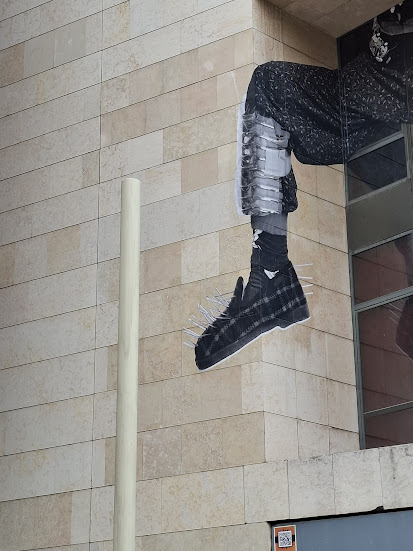
Any individual that you see totally exposed on the streets is a person, first of all. This street-art project has different chapters; the images I´m posting are from Visibles and Hostiles. The projects aim to present the persons, with the idea to humanize and bring acceptance to the table, by using fashion.
It´s already well known that street fashion influenced some great designers, and among the most prolific influencers are the homeless people. Adapting to a life without basic needs means also that by not having access to a warm home, during the cold season, there will be layers on.
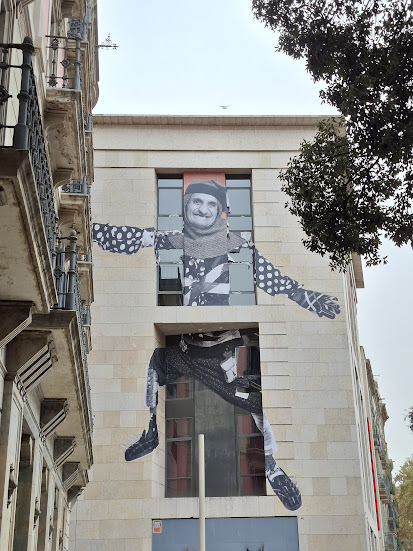
In this social art project, the layers are chosen by a designer; there is a team, with a well-known photographer behind, but the person remains the same. The central focus is the individual, whose styling is showing up personal characteristics, ludic, and cuteness. Inoffensive personalities, many times atypical. The clothing, how we choose to dress, is also a modality of communication, besides its functional role.
As a modality of communication, it touches on any possible subject, and the first important issue when discussing street art is the recycling and upcycling possibilities. By default, people without a roof are dependent on charity and recycling, but that is only because the planning of inclusion is failing. In a coordinated society, having a huge wardrobe that you´ll be throwing away, probably without even wearing it, makes no sense.
Upcycling art, on the other hand transform an item, personalizing it, to the level of forming an identity. In conclusion, socially speaking, a person without a roof might have much more creative processing skills visible in the upcycling choices than a rich individual, who can buy any fashion item, but wears it boringly, has no taste, therefore, the creative processing is invisible.

Here is an example of creative processing in fashion: it´s the helmet lady on the globe. Fashion, in this case, is a anti war manifesto, with a ludicrous presentation of a soldier woman, Geni, standing in an army position. The clothing and photography are collaborating to enhance the importance of women in our society, that we treat them like soldiers to send to war, and that there is still more to be done until autonomy is reached. And women need autonomy to protect themselves. The message hits twice, due to the conflictual international situation that obliges people to search for safety and migrate, trying to find work and a life somewhere else.
Hostiles challenges the very idea of urbanity, where marginalized people have no choice but to adapt and become urban warriors. The phenomenon of exclusion extends to architectural style, which in recent years has become increasingly aporophobic.
Visibles demonstrates that creativity is inherent in every person, and that it can stem from a highly disadvantaged background, stigmatized at its peak, yet still be magnificent, even poetic. In fashion, the work is about composition, and each element finds its place within it, integrating into the structure, becoming part of the plan.

The question is, why isn't everyone included in a plan, if an inclusion strategy is an obligation for any city, and an effective intervention in such a case is called an individual plan? Therefore, regulations change to reflect the characteristics and needs of the individual, of every individual, without exception.
The support system is inconsistent, as training and employment support are lacking for young people and middle-aged adults. However, exceptional situations that trigger a life crisis can occur at any time. There are many types of challenging situations, and we have legislation and planning to intervene and anticipate disasters and the extent of trauma.
We simply need teams capable of adapting the plan and applying it in a way that is congruent with the individual. The idea is to match the plan with the individual.
 Underground Art & Literature - open access to culture