Painted Textile Art: Daniela Cristina Gagiu
Curatorial Storytelling: Oana Maroti
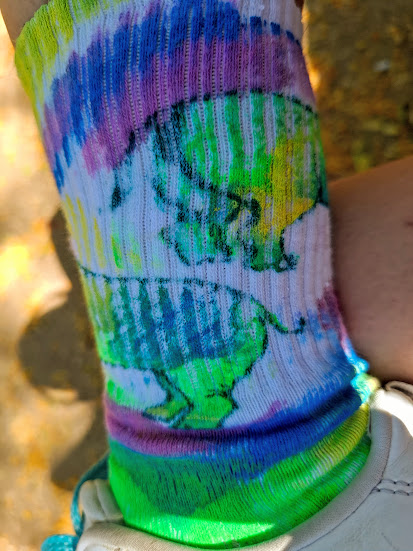
Miniature painting exhibition on socks, with pastel rhino buts, from the Rhinos painting exhibition by Daniela Cristina Gagiu, the outdoor expo items. As painting can change surfaces, the transition between the arts, exposed in a gallery or museum, and the arts exposed outdoors is easy to make. Gagiu engages in a direct demonstration of wearable art, exposing a part of her work on clothing.
As art speaks, and composition is like a matrix waiting to be decoded, these manually painted socks are paired with second-hand shoes, and the recycling art subject, anticipated by the upcycling art, becomes obvious to any curator.
Art by default is communication, so what the artist wants to communicate here, using my legs and low-income life, consisting of a lot of walking?
In the moment I´m presenting this work of art, I´m in a total recycling situation, and barely surviving. I find myself in Barcelona, where I dreamed to pursue my research, as in Europe, there were only 3 main cities where the Inclusive Planning was starting to seem organized, at least in theory. In practice, I´m in a bad place, as institutions, research opportunities, and even the linguistic possibilities of expression are guided by closed minds. Luckily, the migration factor and the creative fusion of the random people in this city made it possible to not have a generally terrible experience in Spain.
In fact, Barcelona attracts many atypical thinkers from all over the world, because of the artistic movement of the refused, the Mediterranean coast between the French and the Catalan area, with access to the sea. The refused artists made their own saloons and art exhibitions, distinct from the elite art, which was less flexible, and did not yet understand that artistic expression is communication, and were still into establishing strict aesthetic rules, thereby excluding emerging artists who reached a different form of expression. Everything we now enjoy visually is based on the work of the refused and others misunderstood communicators, who dared to pursue another perspective.
Experiment and adaptation imply creativity and are essential for society. The underground culture is by definition a place of experiment and new forms of expression, as the resources influence the art, yet low resources could mean extra abstraction, forced by circumstances to excel, as is the case with sequential arts or fashion.
Wearable art items might appear in the subway, and it´s not that much of a surprise, as the creatives often prefer public transportation, for it´s eco-logic. More than that, the underground culture influences and sustains recycling and upcycling ideas.
It´s the workers' realm of transportation; therefore, shoes are not always new, and if you have a stain on your white socks, it´s a good moment to use those socks as a creative surface. Not everybody has money for a fancy canvas, and, in the eyes of creativity, nor should they.
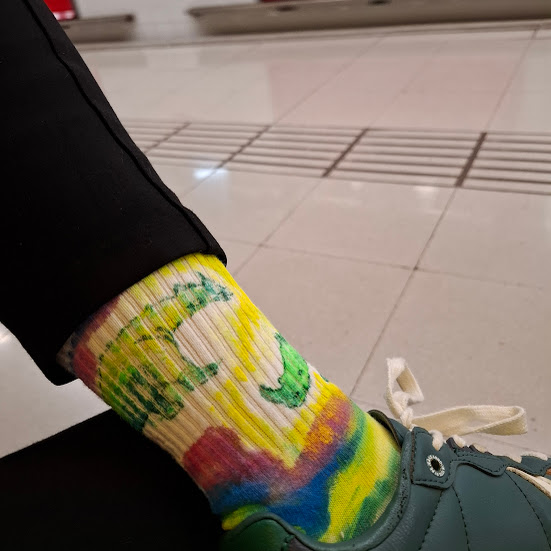
Anyhow, I have many pairs of interesting socks, and I like them with patterns, not monochrome, yet these Rhino Socks are special pairs. They make me content with wearing them, as designed after me. From a distance, I´m wearing colors, diversity, and from close, around my ankle, there is a painting that, by being in rotation, appears sequential. Presenting these socks in the underground seems legit.
Besides the environmental protection message, these painted socks stimulate the absurd style connaisseurs to remember Eugen Ionescu, and his genius theatre plays, who influenced the international imagery so much. The society is transforming, but are we transforming towards development and the end of conflicts, or are we going around without coordination, transforming into something violent and undesired?
A small, hardly visible fashion item presented on a reality social platform catwalk, like the subway, or the streets, wants to make the link between cultures. In this case is a Romanian art presentation, connected with Franco-Romanian culture, on a Catalan metro platform, and defines a part of my trajectory in Europe, as a worker in different countries.
Socks are made for wearing, and are a basic item in a person´s wardrobe, hygiene, and functionality-wise. Like other basic human needs items, they are a part of the quotidian and a possible artistic manifestation, whether by themselves or as part of the composition.
As I´m the one wearing these socks, I´ll add a feminist slogan to them: Not a trophy!
 Underground Art & Literature - open access to culture