Mural Art Project: BesArt The River Museum
Curatorial Storytelling: Oana Maroti

A story of industrialization, migration, and habitat protection.
Human populations developed around the river plateau and coexisted with the natural ecosystem, forming enduring cultures that we now call indigenous or fishing villages—in other words, our ancestors. This cultural heritage is immense, and industrialization has endangered it, as has the ecosystem, because a river culture depends on the river habitat.
When we look at a river map, the illustrations seem like veins. For our planet, rivers are the circulatory system.
River means life, water, travel, trade, an ecosystem of abundance, but also flooding and contamination. The last 2 are deadly and have affected populations since the dawn of time. While flooding is an effect of heavy rain or extra snow and insufficient infrastructure, therefore, the natural disaster is implied, water contamination is mainly human action, the most stupid type of action and business.
For both situations, we have prepared an entire program of reaction, and each society has a natural disaster prevention plan, if they are not extremely corrupt. In the case of flooding, which can occur annually and is a persistent problem, human society also has an intervention plan with specific steps that are clearly outlined. What is not clear around the subject, and hardly touched, is the social support, as many people in the area were affected, and the river's waters destroyed many houses, took many lives, as the architectural plan was inefficient.
It´s not the first time I've write about the Besos River, and I´m interested in all the rivers and deltas, if only I could afford the food and travel, and survive a little longer than I´m obliged to.
I have reached the Besos river by mistake, a few times, and left as fast as I could, with my foot bike. This river meets the sea, and in the meeting area, the air was unbreathable until not long ago. Even if there is a habitat protection project going on, if the waters continue to be contaminated, as happened again in 2024, all habitat protection work is destroyed. We cannot make efficient chain intervention projects if the main danger is still there.
The prevention plan is more than important as it could prevent disasters, and the first step in stopping contamination would be to stop the activity that is polluting the area, as waters are shared and protected. Rivers are not individual spaces of waste dumping.
Even after the recent contamination, the habitat is recuperating, the fish repopulate, the libélulas are huge, and the animals appear. A fox was seen recently, and that´s rare, but the rabbits' community is larger, so the fox´s presence is a consequence.
The river habitat is essential for birds. All kinds of migratory birds, long-legged water birds included, spend the day here, fishing. Some, like egrets, live in the city and raise their young in the Ciutadella Park Zoo, on top of the trees. The parents fly each day some kilometers above the city´s railroad and infrastructure to the river, in search of food.
I´m used to huge rivers; these are quite small, but the culture that forms around them is similar, and the river plateau, once cleaned, maintained, and adapted, becomes an inclusive space of serious importance.
A few years back, I was sent to this area to work as a multilingual interpreter, specialized in Psychopedagogy. Hardly paid, but implicated in what Psychopedagogy means with all my heart and free time, I have accepted and started to work with immigrant women's support institutions and school inclusion intervention teams all over Catalunya.
When I was first send to Santa Coloma I was happy to see a new building dedicated to neurodivergent women support and their children, but in a few months the reality hit me like the pestilential contamination smells hits, and after some meetings and experiences that had nothing to do with protecting women and children, quite the reverse I have refused to work with the concerned institutions, complained about what was going on, and even send an intervention project proposal, as what I had witnessed seemed medieval mentality forced to modern times.
The ¨inclusion teams¨ coordinators and implicated persons showed a display of concerning traits, like xenophobia, aporofobia, and even ableism, that was shocking. I have seen how women can traumatize mothers and how xenophobic bullying is more than accepted, justified, and even sustained, and I have observed that the inclusion plan is not functional, and the personnel have no idea how the linguistic transfer is made, or what the specificities of such transfer processes are for a neurodivergent personality and migrants.
Anyway, after that, going back there isn't necessarily pleasant, and I'm not the only one who thinks the same thing. My partner was also verbally abused by one of the employees of these establishments, who accused him of being "weird." As a result, if we go to visit the river, we avoid crossing the street in front of this new, yet worrying, establishment, or use the public transport from another metro station.
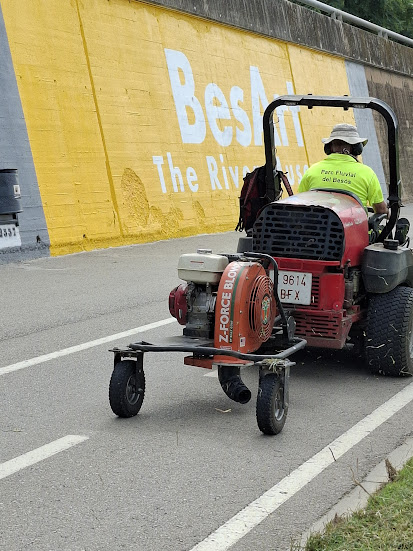
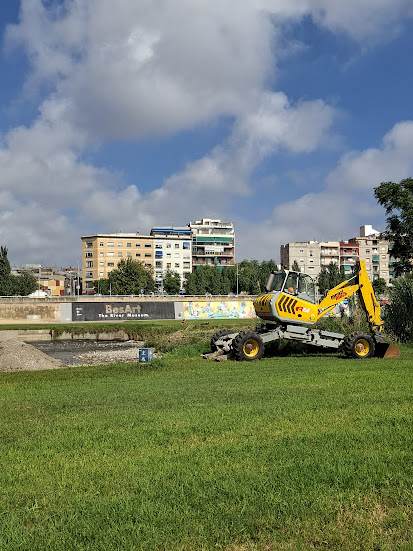
Back to the Parque Fluvial del Besos, where the birds run the waters, and fly in a science-fiction scenario, above the giant bridges, and the green platform looks infinite. On that platform, people walk their dogs or get together, since the river is cleaned. All along the park there is a huge bicycle circuit, on both ways, parallel with the lateral roads, and people seem to enjoy the space. The laterals are delimited by big cement walls, on which each year new mural art paintings show up, and having free access to culture is something extremely important for me; therefore, I have started to document the outdoor art using my phone.
Such outdoor projects that transform grey, ugly walls and have an environmental protection narrative are great for the inclusive strategy. The fact that the neighbors can smell fresh air again changes the life quality, and life expectancy. Plus, having nature´s presence and an open view to a big green plateau is wonderful. I think that it lacks some electric stairs and elevators, and for sure some benches, fountains, and toilets.
Vue that the fluvial park arrives in areas of Barcelona that are feared, like La Mina area, which struggles with criminality, substance abuse, and poverty, an underground cultural approach was imperative. The people in the area were evicted from other neighborhoods like Montjuic or the Barcelona beach, so that tourism can flourish, and poverty stays away from the central areas. These aporophobic decisions affected even more the population in La Mina, but the people there are fighting for dignity. They have been stigmatized, sent away, and forgotten. The story of this area is so heartbreaking, and the people were marginalized for such a long time, and it´s still happening, that fast reactions and functional projects are needed. Instead of social support, they had evacuations and mistreatment in a very medieval way. The first school was made so late that I could not imagine such poor management.
There are documentaries about La Mina, in Spanish, that I´m inviting any person visiting Barcelona to watch. It´s a parallel world, but it´s the reality, uncosmetized. It´s the larger neighborhood in Barcelona; therefore, what happens with the population here, that they feel seen and included, is imperative.
I have studied juvenile delinquency, then worked with people in vulnerable situations, therefore I can appreciate such an approach and imagine it much more complex. With gardening activities and an adapted space, in the upper level, all the desolation in the area can take a different turn of events, but the first move is social care.
Social care has the same effect on people as cleaning the river has. We, as external factors, can do anything, even rehabilitate, recuperate, like we did with the river. The process is slow, and not always give the expected results, but our expectations are usually exaggerated.
A person who is confronting the cold streets and lack of stability or basic support is a warrior already, for having survived such trauma. The next step is to keep them alive, starting to include and humanize them, as excluded and dehumanized, they have been enough.
 Underground Art & Literature - open access to culture