Mural Art Project: BesArt The River Museum
Curatorial Storytelling: Oana Maroti
There are places of beauty, where rivers are passing in their travel, then intersect and make their way to the sea, to the ocean. In those places, people to this day coexist with nature, where nature remains. Many of those places of abundance were corrupted or even destroyed by mining, farming, agricultural exploitation, industrialization, and now the fashion industry, which uses them as trash bins. When nature was marginalized, seen as something parallel to our existence, we began to pollute the waters and endanger species.
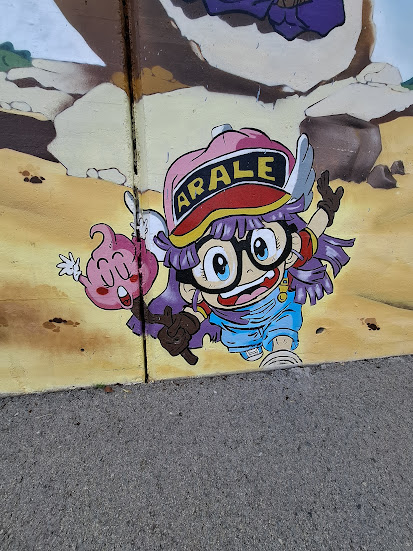
The area I´m writing about is under bridges, and was a chabolas place, barracas, baraci (not barcos), temporary homes made from what people could. Until today, it´s common to give poverty negative connotations or consider it aesthetically unappealing, but when people´s lives are at stake, functionality is what is important, and it would be nice to focus on.
The largest neighborhood in Barcelona was formed by workers and people who had lost their homes due to political upheaval, military conflicts, or natural disasters. The same people who lost their homes because of flooding and were forced to seek a place elsewhere were not helped, left in invisibility and total misery, forced to constantly relocate.
Changing one's social status involves having access to basic human life conditions and employment; therefore, an income is one of them. As migrants, or people from other areas of Spain, find difficulties in integrating into the receiving society that´s pretty much exclusivist, more and more neighborhoods are forming around central neighborhoods, where poor people and workers are still kind of feared, and the desire is many times not to mix. Until today, aporophobic manifestations are to be seen in so-called ¨good areas¨.
In contemporary times, even La Mina, that is the neighborhood of the refused, by excellence, has 2 variables, which divide the area into the poor and the rich, a very aporophobic social development, in parallel with the inclusive strategy.
The arts world is also divided by the same aporophobic system, and prefers not to integrate, but occasionally, underground projects. Huge mistake, as underground projects are in fact super complex plans of intervention, in the majority, and should be considered as such. The aesthetics rules change, as the life rules and challenges are others. Without an income, entire families rely on creativity and, many times, ancient knowledge.
Situated along the river, the river culture forms, and here, the mix of populations that lived along the river plateau all over the world is quite impressive. At a closer look, the woman´s knowledge and implication in society assured its survival, and BesArt The River Museum pays tribute to this knowledge.
Large Mural Art entitled Amazonas, as a dedication to the women´s culture that was such an influence worldwide.
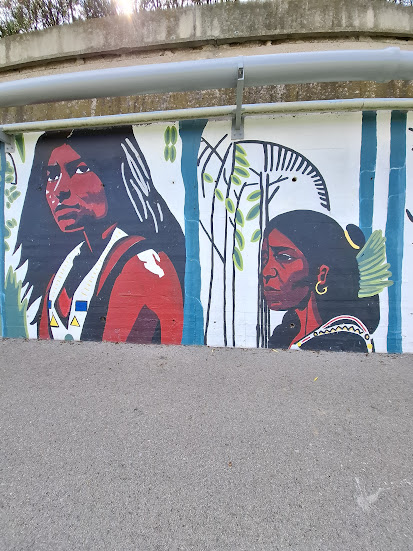
Amazon is the longest river on our planet, and it is named after the warrior woman tribes that lived along the river. Imagine the importance of these ladies.
Historians and colonialists describe these women as musculus, tough, fighting as 10 men at once, tall, and super-skilled with arrows. An occupying attempt went wrong, as Amazonas were so fast with the arrows that they made the enemy look like a porcupine in the blink of an eye.
In Spanish, Amazonas means: Mujer que monta a caballo, and there are songs about these incredible warrior women, guerreras, very skilled in horse riding.
Their culture was not all flowers, as they were sometimes cruel with the male children they had or sent them away. There is also evidence that many of them left the tribes and formed families, and became a guidance in the village due to their craft knowledge, and survival skills. The indigen river cultures are formed by them.
The fabrics and patterns created in these cultures are extraordinary, and carry with them the nostalgia of the world, once called home, and all others they called home. Some historians sustain that the Amazonas and Amazigh populations have shared cultures, and for sure, these women were travelers.
For the Greeks, Amazonas were fascinating. They appear in battles and fight Heracles (Hercules). Homer writes about them in Ilíada, situating the warrior women in the Danube River area. Herodot also writes about the warrior women, saying that they are fugitive women who led a nomadic life.
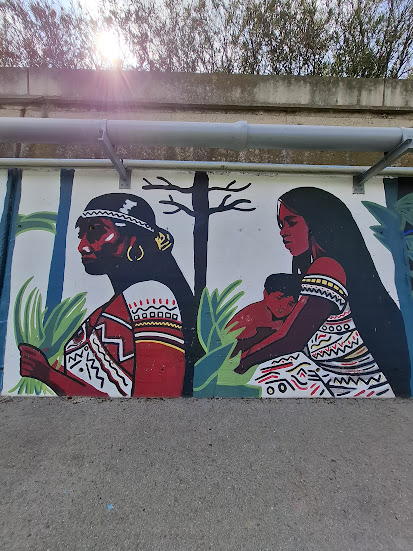
Amazonas were great at hunting, fishing, and also at attack. Hippocrates says that they had only one breast, and that the other was cauterized at birth. He adds that it was for developing muscle, but I wonder if he was accurate. What is left aside from the abundance of descriptions about these women, and the most interesting aspect is the cultural exchange they made in the whole world. These ladies travelled and knew plants, animals, and survival techniques; they were implicitly the doctors around.
We know about the implications in agriculture that the presence of a river has, and we also know that the warrior women were skilled in pottery techniques and pattern creation. In a pre-writing world, some cultures used mud to make pottery and painted or engraved motifs inspired by nature. Same motifs were used in clothing, and the textile world, and fashion related to the river culture is immense, interconnecting via what we call folkloric motifs.
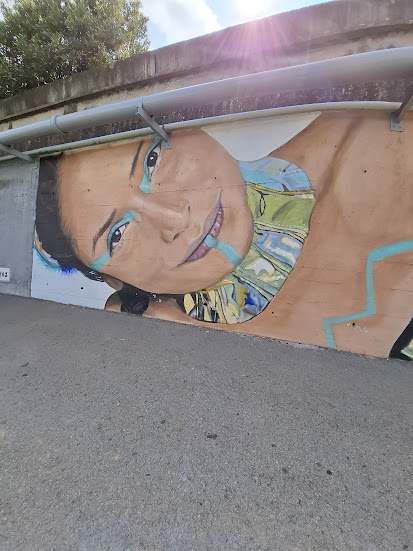
The influence of Amazonas in fashion still echoes today, but we are just not used to giving credit.
Vibrant body-painting and maquillage, accessories, fascinating color combinations, imitating nature.
This is a giant woman, on the lateral, painted on 3 walls. She challenges the viewer with her indigen beauty gaze, she is wearing a beautiful dress, which could as well be a big event dress, and her nails are painted black.
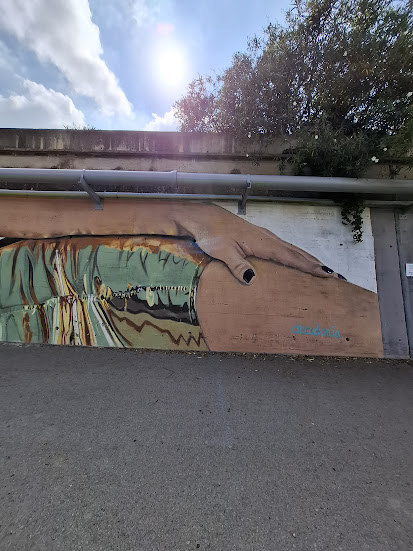
Each time an area is induced into vulnerability, women suffer greatly, and their rights are destroyed; their precious personal space is occupied. If once women were self-sufficient and could rely on their skills to survive, the modern society reversed the situation, and now we are at the point of fighting for basic rights, which are in the personal space category. Our body belongs to us, and what we choose to wear in what many colors, whether it shows skin or not, is entirely our business.
Human society was formed and shaped by strong women. In case anyone has any doubt, the arts and crafts, popular motifs hold this transmission, as a nonverbal communication, a visual support for their songs, and ancestral stories, mothers, grandmothers, and women everywhere were transmitting, before written language appeared. In fact, it is a graphic transmission, therefore an extended graphic language. The indigen patterns are a base for so many other systems.
I´m implying that observing nature and coexisting with it is very clever, environmentally friendly, and that the indigen cultures are to be protected, therefore consider migrants as a relative from another part of this world whose influence we cherish. At a closer look, comparing cultures, an extended family.
To be continued…
 Underground Art & Literature - open access to culture