
Mural Art: El Rughi
Storytelling: Oana Maroti
For millennia, we have communicated, traded, drunk, and eaten together. We have created a culture of mutual understanding on a global scale. Considerable work has been done to facilitate the transmission of messages, and the general message is: "Peace, end of conflicts!"
Tea culture is somewhat different from what is generally imagined. First of all, it is not tied to a single plant, contrary to what commercial classifications have led us to believe.
All over the world, people began boiling water as a precaution, and sometimes herbs, spices, or fruits are added, either to modify the taste or for their medicinal properties.
The culture of herbal teas is vast. Besides the cultivation of Camellia synesis tea, there is the culture of traveler's tea, widespread throughout the world and an integral part of culinary culture.
Knowledge of plants and their properties has transformed our lives and allowed us to survive in harsh conditions.
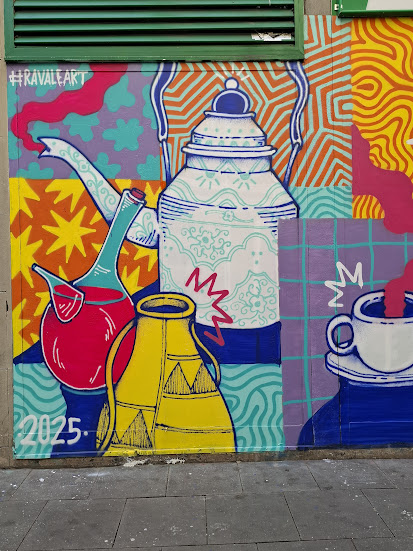
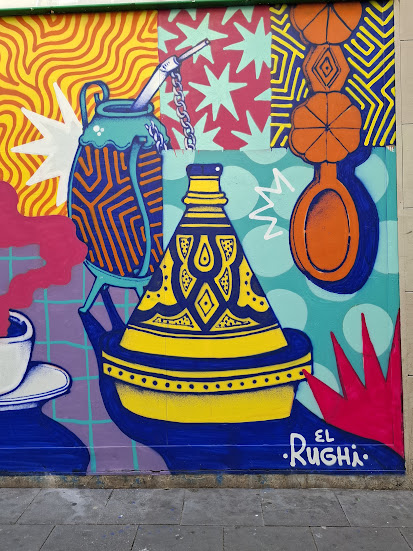
El Rughi presents a graffiti artwork dedicated to the multiculturalism of the Raval neighborhood. The piece depicts various tea accessories used around the world. Tea culture is the most inclusive form of social consumption, as everyone has their own favorite infusion, and those intolerant to theine also have a choice.
Originating from a cold region of Transilvania, a land of travelers, tea is essential to us, and its consumption is an integral part of our seasonal culture. We drink it in the morning, afternoon, or at dinner, accompanied by specific pairings, depending on the tea.
Living in an international context has allowed me to have pleasant conversations about tea with people from very diverse cultures. Enjoying tea is about sharing a convivial moment, inhaling the aroma of herbs and spices, feeling the warmth of the cup in your hands, which, when cold, brings comfort.
A cup of herbal tea stimulates the sense of smell, warms the body, hydrates, and creates an atmosphere conducive to peaceful conversation.
It's 2026, we speak different languages, and we have translators. In theory, we are more capable than ever of understanding each other. Millennia of human history have been dedicated to teaching negotiation and intercultural communication. In essence, we have already dismantled war and signed agreements.
Let's remember why.
<-><->FR
Le Thé du Voyageur
Depuis des millénaires, nous communiquons, négocions, buvons et mangeons ensemble. Nous avons créé une culture de compréhension mutuelle à l'échelle mondiale. Un travail considérable a été accompli pour faciliter la transmission des messages, et le message général est : « Paix, fin des conflits ! »
La culture du thé est quelque peu différente de ce que l'on imagine généralement. Tout d'abord, elle n'est pas liée à une seule plante, contrairement à ce que la classification commerciale nous a fait croire.
Partout dans le monde, on a commencé à faire bouillir l'eau par mesure de précaution, et parfois on y ajoute des plantes, des épices ou des fruits, soit pour en modifier le goût, soit pour leurs propriétés médicinales.
La culture des tes aux herbes est vaste. Apart de la culture du thé de camélia synensys, il existe la culture du thé du voyageur, répandue dans le monde entier et faisant partie intégrante de la culture culinaire.
La connaissance des plantes et de leurs propriétés a transformé nos vies et nous a permis de survivre dans des conditions difficiles.
El Rughi présente une œuvre de graffiti dédiée au multiculturalisme du quartier du Raval. Le tableau représente différents accessoires pour le thé, utilisés à travers le monde. La culture du thé est la forme de consommation sociale la plus inclusive, car chacun a sa propre infusion préférée, et les personnes intolérantes à la théine ont également le choix.
Une tasse de thé aux herbes stimule l'olfaction, réchauffe le corps, hydrate et crée une ambiance propice aux conversations paisibles.
Nous sommes en 2026, nous parlons différentes langues et disposons de traducteurs. En théorie, nous sommes plus capables que jamais de nous comprendre. Des millénaires d'histoire humaine ont été consacrés à l'enseignement de la négociation et à la communication interculturelle. En substance, nous avons déjà déconstruit la guerre et signé des accords.
Rappelons-nous pourquoi.
 Underground Art & Literature - open access to culture