Curatorial Monologues, essay fragment on Found Books by Oana Maroti
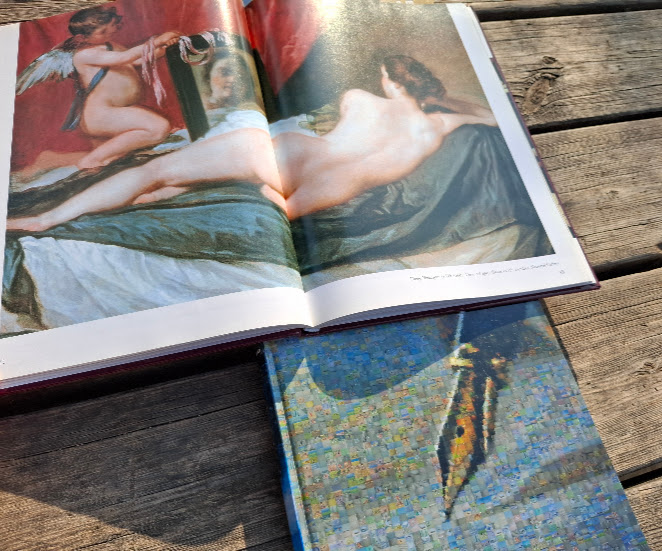
This morning, while performing my flight exercises, I came across some books; I examined the one on Universal Literature and discovered it was a Spanish-language teaching manual. Beyond a brief, intercultural-style introduction to figures in the humanities—such as a single sentence on Mircea Eliade, without even mentioning the work so many of us have studied—the text limits itself to the literature of the auto-proclaimed great powers: the colonialist ones. Undoubtedly, this specific example represents a compendium of Catholic literature and a form of implicit indoctrination rather than a genuine overview of universal literature. Russian literature is highly valued, yet the Eastern European literature that influenced it receives barely half a page here and there. The manual prioritizes American literature—its primary influence—and shows greater appreciation for Shakespeare than for French theater. And, of course, women barely feature in this "universal literature"—perhaps because what is actually being presented is colonialist literature. In the occupied territories, however, there is an abundance of female writers, playwrights, and poets. To grasp concepts—rather than merely engaging in today’s "creative repetition" or an education rooted in astrology, nice hair, or ceremonial coats —we must decolonize and broaden the scope of universal literature. There exists another extraordinary form of thought, transmitted over millennia, which has been reformulated—or rather, squandered—amidst imperialist opulence.
Fundamental concepts are missing; consequently, artistic expressions are reduced to mere copies and hollow replicas. We create to solve problems, communicate better, and connect cultures—not to manifest racism or any other form of discrimination. Ultimately, colonialist education is insufficient for the present day; in reality, it is a problematic form of education, unrealistic.
Decolonize language! Universal literature is not represented by just a few countries. Expand knowledge to the source!
 Underground Art & Literature - open access to culture