
Found Book Review: El Malestar de las ciudades by Jorge Dioni López
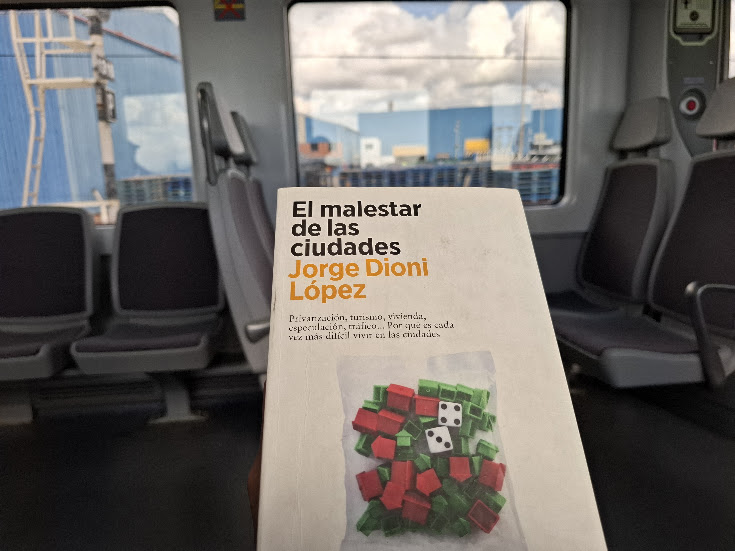
The Discontent of Cities, by Jorge Dioni López, is a book I found on the streets of Barcelona. It's written in Spanish and presents the state of heritage in Spain. It's a well-executed piece of journalistic investigation that begins with the question: What is a city?
This question takes on maximum relevance in the context of October 2026, right now, when people in Europe are demonstrating in search of housing. Access to a decent life and housing is something we all need; it's the foundation of our development. Without a home, we can't study, work, or plan for a family's future.
I've been reading this book on public transport, around the city, and I've discussed it in my outdoor office. When you don't have the stability of a home, an outdoor table becomes a place to eat, but also a desk.
In Chapter 13, titled ¨Los anos de descubrimiento¨, "The Years of Discovery are focusing on Barcelona. Jorge Dioni López presents the situation in this city, which had a mayor who had worked in New York and Baltimore and who influenced the city's architecture and projects. The city opened itself to the sea, where commercial and industrial activities were concentrated, and where poverty and exclusion were readily apparent. "Barraquismo " (a term referring to informal settlements or informal settlements) was present in Barcelona from 1870 on beaches like Sormorrostro and became a way of life for workers and their families while the metro was being built.
Since then, and to this day, the policy of exclusion has persisted, and many dreamed of autonomy, but only lost money in this city. It's like a parallel existence, as in any tourist urban area.
Buying and renting apartments becomes a national pastime. The term "pornographic" appears in connection with the real estate industry, with apartments destined for this sector, leading to years of exploitation of many migrants. For young people and all those unable to access housing, the situation becomes dire, and many are forced to rent cheap, but dilapidated, rooms. Less affluent neighborhoods are preferred, where more money can be made, and rooms are constantly being rented out.
To obtain cheap apartments, the key is to leave properties unused for as long as possible, until they can no longer be salvaged, thus allowing for the definitive replacement of the population—exactly the opposite of the inclusion plan being implemented in Europe.
Since I got this book, the person who owned it before me left some interesting handwritten notes. In this chapter, "The Lords of the Land," the following is highlighted: the business of exclusion. The same chapter explains that, in risk situations, also known as emergencies, there are four key departments that can develop and implement plans to prevent the eviction of citizens, but they do not coordinate their functions. Their main activity is applying for grants and receiving donations. It should be added that they even seek to profit from donations, as there are shops that resell donated items. The four departments responsible for social support in emergency and risk situations, such as the inability to pay rent, do not coordinate their functions, and that is why there are so many people on the streets, a serious problem today, and Spain has been experiencing protests for weeks due to the housing crisis.
In Spain, most landlords come from other countries; for them, this is simply a lucrative business. Their actions, along with the eviction system, have put entire families at risk. People are being evicted from their homes very aggressively and hastily, and many do not survive the ordeal. In Barcelona and the surrounding area, seniors have recently committed suicide due to evictions, and when you see, in a week two people jump out of a window for the same reasons—fear of sleeping in the cold and dehumanization by a system that exploits workers and leaves them destitute in their eighties—the situation is so deplorable that even considering it a plan is unacceptable. These are criminal acts committed without a second thought. We all need the bare minimum to survive, and that includes housing.
Without a roof over our heads, we can't sleep. If we can't sleep, we can't work. If we can't work, the entire social system collapses.

