
Book Review, Essay fragment for Human Rights by Oana Maroti
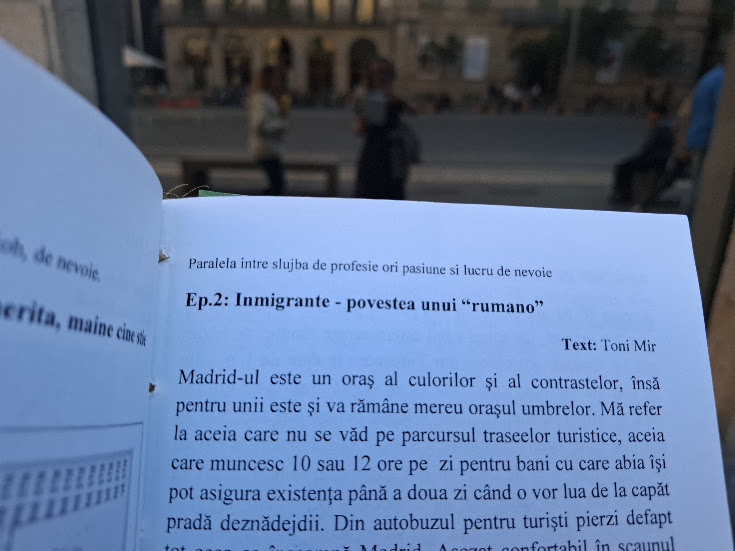
Inmigrante, the story of a rumano is a book awaiting publication, based on Toni M’s work experience in Madrid. Here is a fragment of this humiliating experience:
https://bddebuda.com/2021/05/13/inmigrante-the-story-of-a-rumano/https://bddebuda.com/2021/05/13/inmigrante-the-story-of-a-rumano/
Together with Toni, I started a magazine and a project titled Muddling Along, which I still maintain. We began collaborating after I discovered his manuscript in a cupboard at the restaurant in Cluj where I was working. I read it in one sitting on a rainy day when we had no customers. It was such a raw experience that I couldn’t put it down. We created a blog together—which has since disappeared—and, quite tragically, Toni lost his life in a car accident while I was working in Barcelona. We never saw each other again. I feel a duty to publish his novel, which has also vanished from Conceptivor, his personal blog: https://conceptivorblog.wordpress.com/my-carpathia/
In Inmigrante, Toni recounts his experience in Madrid and sheds light on human trafficking—situations that, unless you are sent by a ghost company or head off to work on your own, you might never encounter. Yet, many of us have found ourselves in a position where we paid a significant sum for the chance to work, went through an agency, and ended up trapped with no way out. Both Toni and I were recruited by Romanian agencies—on April 1st, no less—and subsequently sent to work in the middle of nowhere.
Inmigrante was written many years ago, yet working conditions abroad remain precarious. The stories of immigrants are often presented by the media—filtered through various intermediaries. Our stories, however, are real and detailed—told firsthand, without any intermediary—yet they go unpublished. Writers who engage in social journalism too often die in car accidents; they struggle to survive, and they have no support whatsoever. Real-life experiences—unfiltered and unedited—are often lost, and with them, the opportunity to observe and take action regarding inclusion, whether at a local, national, or international level. Working abroad should not put our lives at risk, yet, all too often, that is exactly what happens.
Toni M. presents the reality of Madrid as seen through the eyes of a migrant worker. He describes, in stark terms, what it’s like to work without being paid, or to toil to the point of exhaustion in a shady chicken-processing plant; he recounts the lengths to which hunger can drive a person—even leading them to steal food from a roommate’s fridge. These are the unexpected survival challenges one faces when setting out to find work abroad.
Human trafficking originating from our country is alarmingly common, yet it often goes unnoticed. Individuals might be recruited for "work" right in their own apartment blocks or villages by someone posing as a "boss," only to be whisked away to an unknown location—forced to labor in silence. These people are frequently kept in total isolation; if something goes wrong, their existence rests entirely on the "boss" will. And that is not even touching upon the trafficking of women—a national emergency, the stuff of 1990s crime dramas were not just movies. These situations, which can end in tragedy—and which should never occur in the first place—are often foreseeable. People put themselves in harm’s way out of sheer desperation; they need to work and earn a living—otherwise, they would never leave. If something happens along the way—and, as we see, atrocities occur all too often—it seems that no one cares. This makes Romanians easy targets for human traffickers.
Toni himself once paid for a round-trip ticket that turned out to be a fake, leaving him with nowhere to turn for help. There is a prevailing, yet false, notion that if you get swindled, it’s your own fault. Meanwhile, "ghost" recruitment and transport agencies continue to operate, growing rich at the expense of others. Toni has also written science fiction and horror, but his storytelling of direct work experience and the reality in the suburbs of Timișoara are his most terrifying texts. It is impossible to imagine anything more absurd or horrifying.
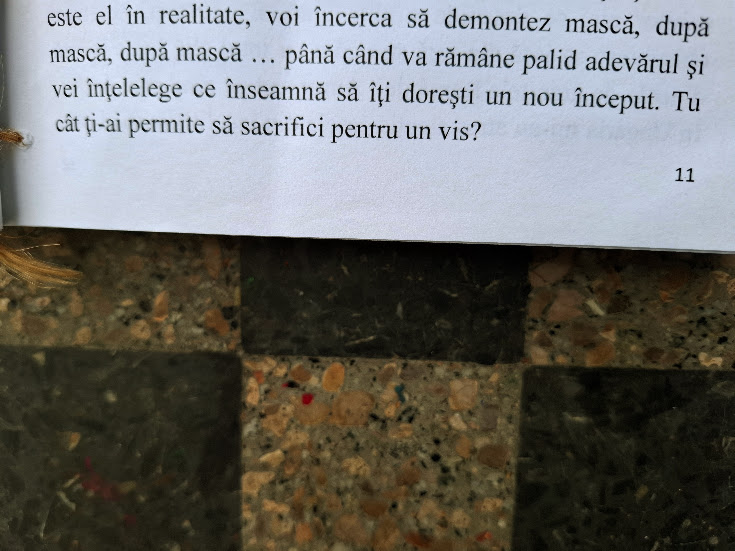
"How much would you be willing to sacrifice for a dream?" asks Toni—a compelling question, given that his own dream was tied to something he could not attain in his home country. Many of us share a similar dream: we either cannot find work at home, or the pay is so poor that we have no choice but to go abroad—to earn enough for a laptop, a guitar, medical treatment, or even a headstone.
We put ourselves in risky situations because we lack the bare essentials—because we are denied basic necessities, and because the level of corruption stifles our development. Migrant workers lose their lives, femicide is rampant, and books that have been written remain unpublished. Why is this?
The case of Toni M. and his work, Inmigrante, the story of a rumano, serves as a classic example—both for the Romanian state and for the host country. Someone undergoes an extraordinary, singular experience, documents it in detail in a book, and then hits a wall when it comes to publication. Such stories should be a priority for publication; perhaps what we all need is a socially-conscious publishing house dedicated specifically to bringing these harrowing migrant experiences in focus. We talk, we write for a change.

